


+2,670%referrals from AI Search
Pleo
Pleo now gets found and cited in AI search across five markets, and the visibility can be read straight off the traffic.

International SEO is the work of getting found and chosen in several languages and markets. The job is prioritization more than translation: each market has its own demand, its own competitive picture and its own technical and editorial requirements. The work sits naturally in a Baseline that covers all your markets.
The same product gets searched differently in Denmark, Sweden and Germany: other keywords, other volumes, a different competitive field. So international SEO begins with understanding each market on its own terms, long before anything gets translated.
We know the job from the inside. Bonzer has offices in Copenhagen, Stockholm and Oslo and clients across the Nordics, Europe and the US. Our own working day is multilingual, and the setup we recommend to you is the one we run ourselves.

Search results vary from country to country. The same keyword can carry a different volume, a different meaning and an entirely different competitive field, and the intent behind the search does not automatically come along in a translation. That is why translated sites so often underperform the original: the content answers questions nobody asks in that market.
The same goes for AI answers. ChatGPT, Copilot and AI Overviews cite different sources in Swedish, Norwegian and English, and it is the local content and the local authority that decide whether you are among them. Every market is its own race, and every race can be won when it is prioritized as its own.
We start by prioritizing the markets: demand, competition and commercial value per country. Not every market is worth the same to you, and the order decides how fast the effort pays off. Every market gets its own keyword analysis, never a translated list.
Then we build the technical frame: hreflang, URL structure and canonicals, so each language version shows up in the right country and the versions do not compete with each other. This is the part most sites get wrong, and the errors stay invisible until you measure per market.
Last, the local work: content written by people who know the language and the market, and authority built with local backlinks. A link from a Swedish publication moves your Swedish rankings, not your Danish ones, and the same pattern holds everywhere.
An overview of demand, competition and your current visibility in each country, pulled into a prioritized order: which markets to win first, what it takes, and where the gains sit closest.
You are about to enter a new market. The choice of URL structure, hreflang and content plan has to be made before the launch, because it is expensive to redo afterwards, and it decides how quickly the new market starts carrying itself.
Or you are already live in several languages, but one market carries everything while the others sit still. Then the content is usually translated rather than prioritized, or technical errors are sending the wrong versions into the wrong countries. Both can be found and fixed.
Hreflang tells search engines which language and which country each page is meant for. Set up wrong, the versions compete with each other, or the Swedish customer lands on the Danish page. We review the setup across every version and hand the fixes to your developers as a task list they can work through.
URL structure is a strategic choice: country domains, subdomains or subfolders. Country domains are strongest locally but demand the most resources, subfolders pool the authority on one domain and are the easiest to run. We recommend based on your ambitions and your resources.
Search behavior we map country by country. The same keyword can have ten times the searches in one market as in another, or mean something else entirely, and the seasons do not always cross the border. So each market gets its own analysis and its own priority order for what to win first.
Content we write locally from scratch. A translation keeps the meaning but loses the search behavior, and the nuances of the language decide whether a page reads as credible or as foreign. People with market knowledge write the content, and our own platform Morrison keeps brand and tone even across the languages.
Authority is local too. Backlinks from Swedish media tell search engines and AI models that you are relevant in Sweden, and the same pattern holds in every market. So we plan links and brand mentions country by country, and no single strong home market is left carrying the others.
And we measure per market: rankings, traffic and brand mentions in AI answers, country by country, so lopsided growth shows up early and the wins can be copied into the next market. It is the same discipline we run across our own three offices, and it sits behind several of our cases.
It depends on ambition and resources. Country domains are strongest locally, but each domain has to build and maintain its own authority. Subfolders pool the authority in one place and cost less to run. We recommend a structure from your specific situation, and most importantly: the choice has to be made before the launch.
A good translation keeps the meaning, but the search behavior does not come with it. Word choice, volume and intent vary from market to market, so the content has to be built on a local keyword analysis and written by people who know the language and the market. Otherwise the page answers questions nobody asks.
The ones where demand, competition and your commercial opportunity meet best. Rarely the biggest markets, but the most winnable ones. The prioritization is the first deliverable in the work, so your resources go where they pay off fastest.
Yes. Our clients sit across the Nordics, Europe and the US, and the method is the same in every market: local analysis, correct technical setup, local content and local authority. From our offices in Copenhagen, Stockholm and Oslo we run work across languages every day.
Yes, it is a standard part of the technical setup. We review the implementation across every language version, hand the fixes to your developers as separate tickets and verify that they work once they are live. The errors are often small, but they cost visibility every day they stand.
A Baseline can cover one market or several. The analysis, the strategy and the reporting sit in one place, while single-market pushes, a launch in Sweden for instance, can run as focused sprints on top. That way the setup grows with you, market by market.
Yes. ChatGPT, Copilot and AI Overviews pull their sources per language and market, so you can be the preferred source in Denmark and invisible in Sweden. Local content and local brand mentions are what make the difference, which is why we measure AI visibility country by country, just like rankings.
Same method, new markets. Two partnerships where the SEO work scaled across countries, and where the growth can be measured market by market.
Pleo now gets found and cited in AI search across five markets, and the visibility can be read straight off the traffic.
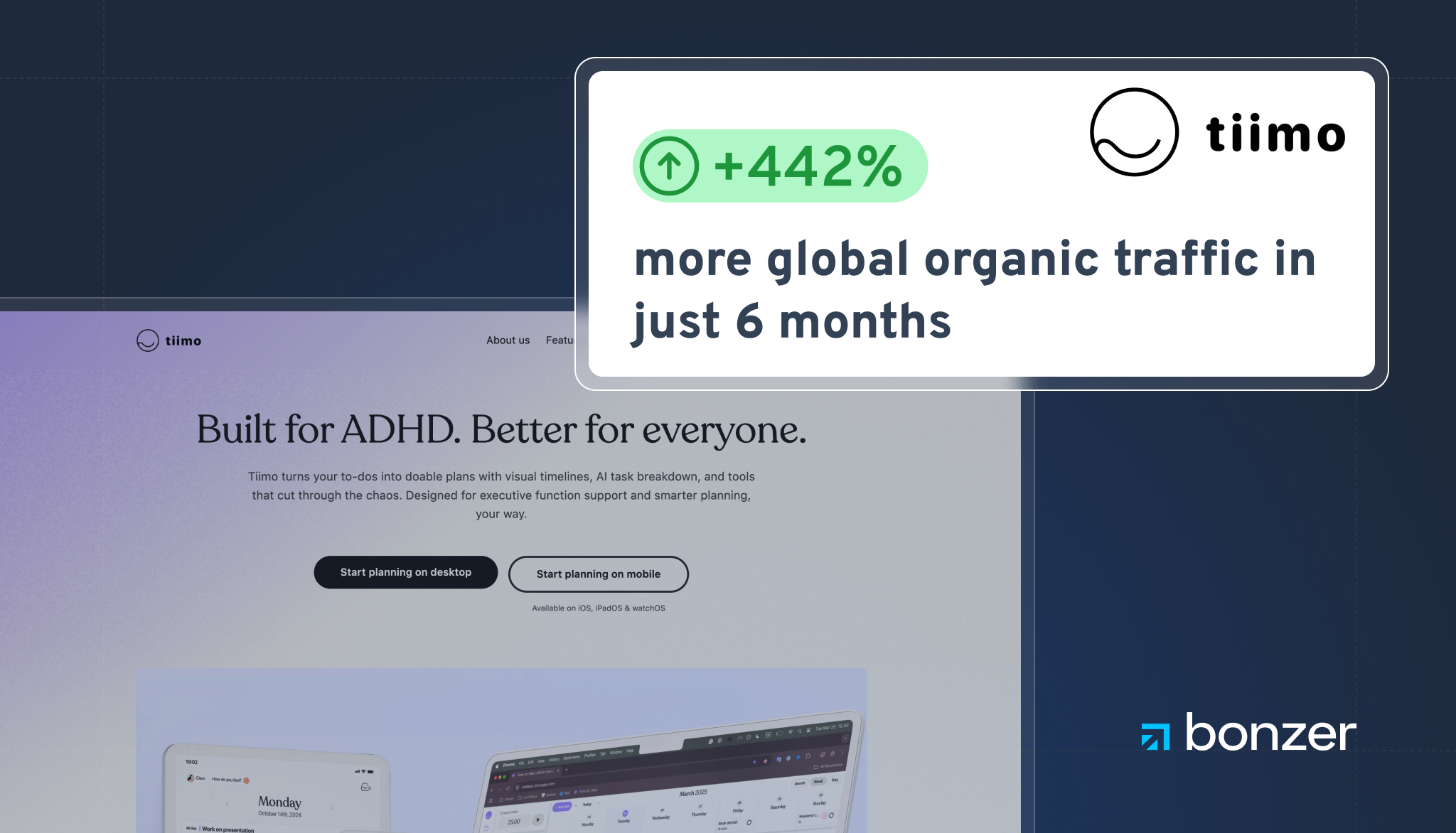

Tiimo wanted to strengthen its global presence. In six months global organic traffic grew 442%, while the app also became visible in AI Overviews and ChatGPT.

An informal analysis of your domain. Classic search and AI-search.
Free SEO analysisBased on experience from more than 3,000 analyses and 1,000+ companies