



+2,670%referrals from AI Search
Pleo
Pleo holds 43.6% AI Share of Voice in business spend management, and referrals from the large language models grew with it across five markets.

AI Search optimization, also called GEO (Generative Engine Optimization), makes your company the source the AI answers are built on. We work with entities, sources, citations and structure so ChatGPT, Copilot, Gemini and AI Overviews name you when your market asks, and so the same work lifts your classic rankings. The deliverable usually sits inside a Baseline.
The underlying principle has not changed: people are looking for companies like yours. What is new is that the answer now comes from a language model as often as from a results page, and that the sources behind the answer can be influenced once you know where the models get their knowledge.
You get one plan that covers Google and the AI answers: which questions to own, which entities and sources need to be in place, and how your content should be built so it ranks in the search engines and gets cited in the answers.

Search is no longer one search engine. Your customers ask ChatGPT for advice, meet AI Overviews at the top of Google, and research in Copilot and Gemini. Each surface picks its own sources, and those choices respond to the same craft as classic [SEO](/seo): authority, structure and content that answers precisely.
That makes classic SEO more important, not less. The signals that get a page ranked overlap with the ones that get a model to cite it: clear entities, consistent company data, and content with a named author and evidence behind it. Build one and you build the other.
We start by measuring. Which questions does your market ask, what do ChatGPT, Copilot, Gemini and AI Overviews answer today, which sources do they cite, and where do you stand in classic search on the same topics.
Then we build the foundation. Your entities have to be clear and consistent across the site and across the sources the models lean on. And the structure has to make your pages easy to cite: direct answers, named authors, and data that can be lifted straight into an AI answer.
Last we prioritize by business: which answers sit closest to revenue, where competitors own the citations today, and where a lift in classic rankings and AI visibility move together. All of it lands in a backlog, so you can follow the progress month by month.
A measurable starting point: how ChatGPT, Copilot, Gemini and AI Overviews describe you and your competitors today, which sources they cite, and how that lines up with your rankings in classic search.

Your category is being researched with AI, but the answers rest on whatever happens to be there: old articles, half-decent comparisons, sites written for another market. That slot is yours to take, and a first choice is hard to dislodge once it has settled.
You are strong in classic search and want that authority to carry through into the AI answers. That is often an obvious focus for the first sprints on top of your Baseline.
Entities are the backbone. Models and search engines need to see unambiguously who you are, what you offer, and how you connect to your category. We clean up names, descriptions and structured data so your entity is consistent everywhere.
The sources outside your own site count. AI answers rest on a web of brand mentions, directories, reviews and trade media. We map which sources the models cite in your category and build a plan for being present on the ones that matter.
Structure decides whether you can be quoted. Clear questions and answers, definitions, numbers with a named source, and pages that handle one topic at a time are easier to lift into an AI answer, and the same moves strengthen your classic rankings.
Authority is what separates a source from a page, and E-E-A-T is the craft behind it. Authors with real expertise, evidence for the claims and a clear company profile make you a source the models dare to cite, and a page Google is happy to rank.
Measurement is part of the deliverable. We track how you are described and cited in AI answers alongside rankings, impressions and clicks in classic search, so the AI visibility and the rankings arrive in the same report.
Behind the work runs Morrison, our own AI content ops platform. It reads your entire website, learns your brand from your own documents and connects to your performance data, so the optimizations are built on your reality rather than a template. What that approach produces is documented in our cases.
It usually runs as a deliverable inside Baseline, where it works alongside technical SEO, content and reporting, because it draws on the same signals. If your need is narrower, we can run it as a focused engagement.
We systematically follow how a fixed set of questions gets answered in ChatGPT, Copilot, Gemini and AI Overviews: whether you are named, which sources are cited, and how that develops over time. Together with the traffic those platforms send and your classic rankings it gives one picture.
It depends on the starting point. Cleaning up entities and structure can land in AI answers within weeks, because several models pull fresh sources continuously. Authority and source coverage build over months, the same as in classic SEO. We measure from day one, so the movement is visible along the way.
No, and that is the whole point. The signals overlap: structure, entities and authority drive the rankings and the citations alike. We weight them equally in strategy and reporting, so one effort covers Google and ChatGPT at the same time.
Less than most people expect. We need access to Search Console and Analytics, one contact for subject-matter questions and approvals, and help with implementation if we do not have access to your CMS. We drive the rest.
Usually, yes. Wrong brand mentions normally come from inconsistent sources: outdated descriptions, conflicting company data or unclear entities. We find the sources behind it, correct them where we can, and build the signals that make the correct information the strongest.
Yes. Answers differ per language, so we run the analysis and the optimization per market. Multilingual markets with hard competition and early AI adoption are our home ground in the Nordics, and the same method carries into the rest of Europe and the US.
Visibility in AI search is not theory. Two partnerships where the work toward ChatGPT, AI Overviews and the platforms beside them can be read straight off the traffic.
Pleo holds 43.6% AI Share of Voice in business spend management, and referrals from the large language models grew with it across five markets.
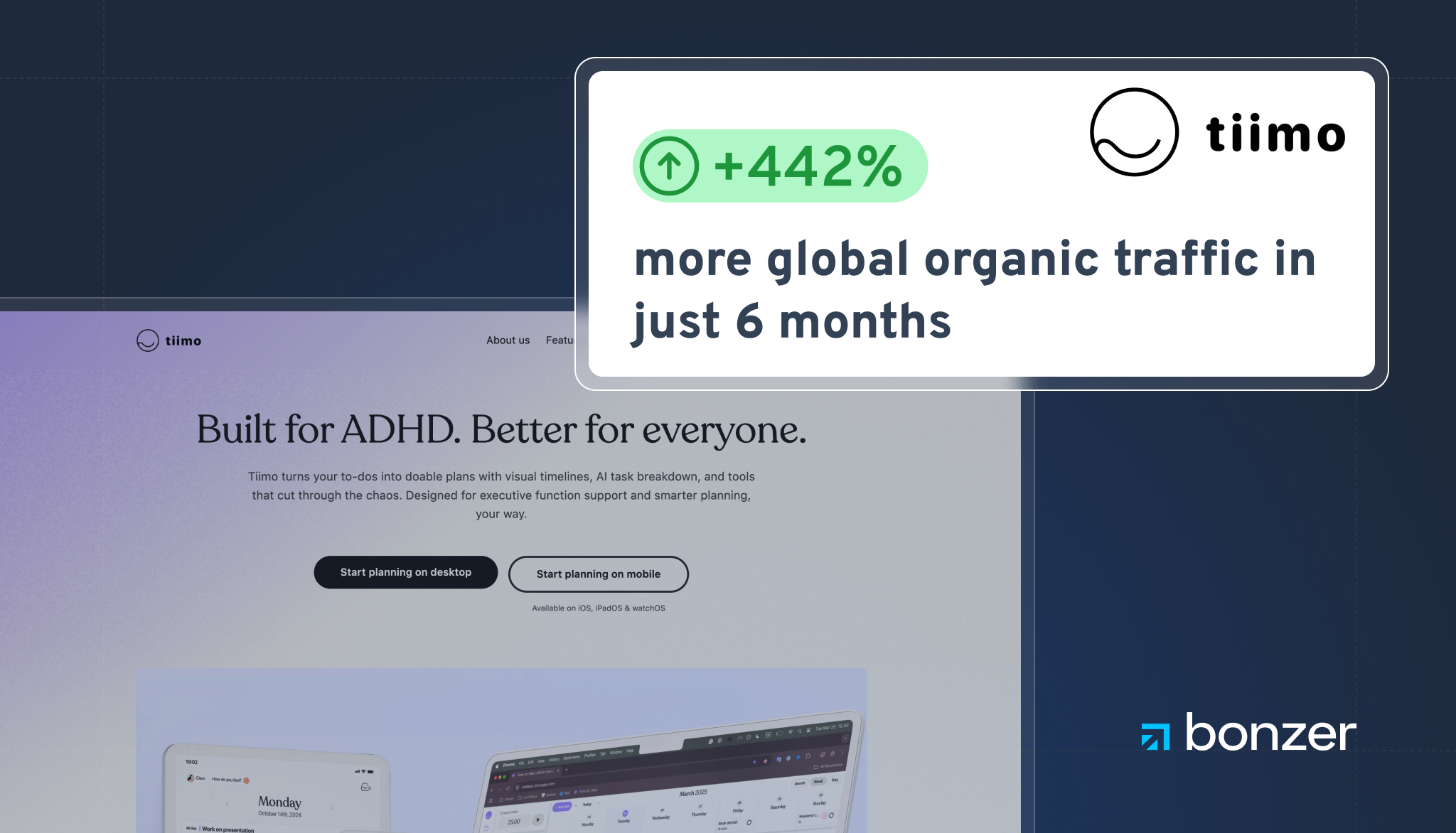

A strategy aimed at Google and the AI platforms at once gave Tiimo 442% more organic traffic and 657% more key events from ChatGPT in six months.

An informal analysis of your domain. Classic search and AI-search.
Free SEO analysisBased on experience from more than 3,000 analyses and 1,000+ companies