

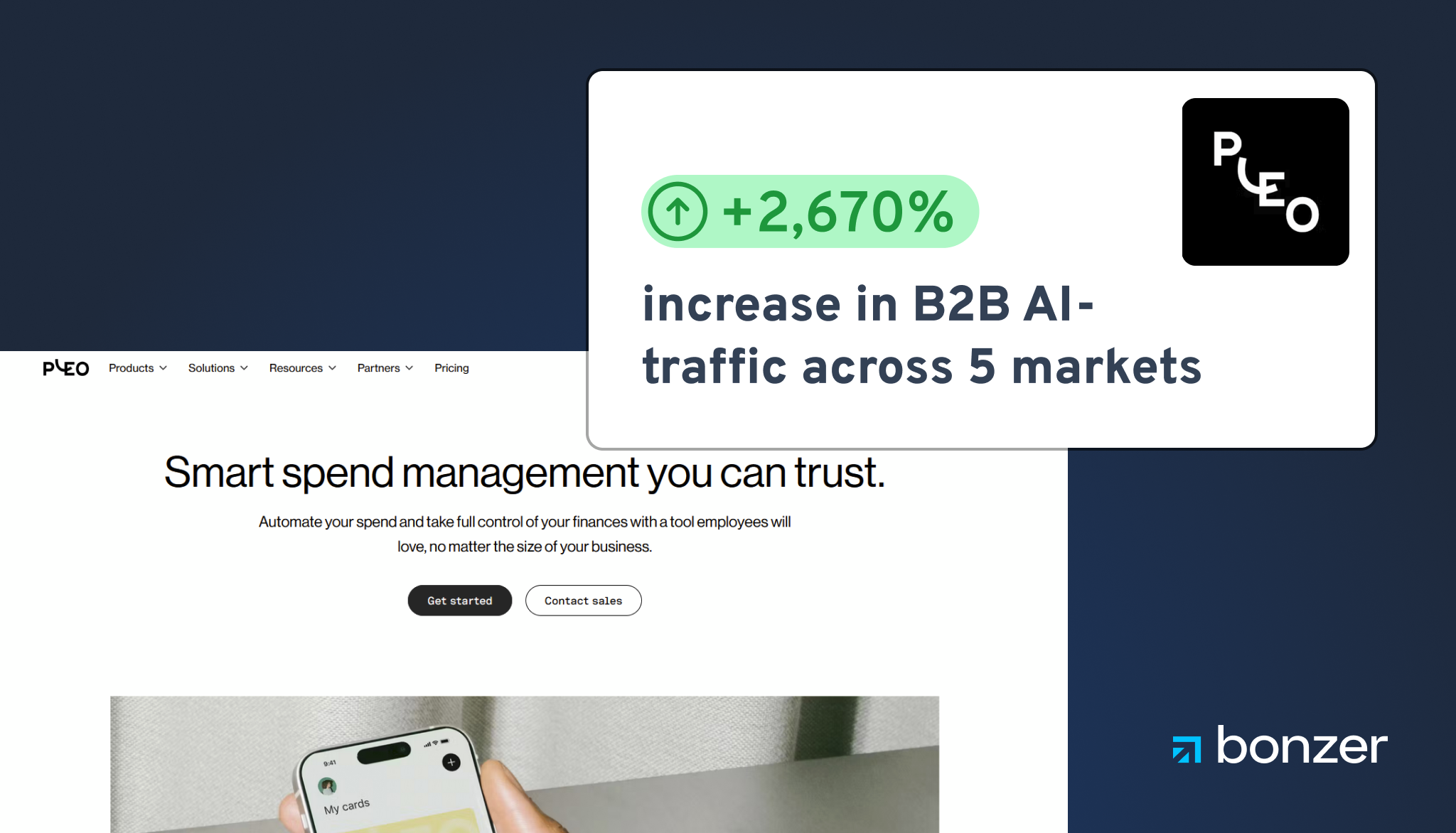

+229%organic traffic value
Pleo
Five dedicated content strategies for five highly competitive markets: Denmark, Sweden, the United Kingdom, Germany and France.

Localized content is content built from the ground up for the market you want to enter. We start from that market's own reality: what people actually search for, how they phrase it, and which sources classic search engines and AI search engines prefer locally. If existing pages simply need to move into a language you already work in, content translation is the right deliverable instead. This one usually runs inside a Content Subscription on top of your Baseline.
Search behavior does not translate one to one. The keyword that drives category traffic in Denmark can be marginal in Sweden, where buyers use a different word with a different intent behind it. That is why every market starts with its own analysis.
The same holds for AI answers. A translated page rarely becomes the source an AI answer is built on. That role goes to the page written into the market's own questions and phrasing, by someone who knows them.

A straight translation usually misses in three places: the keywords (the market uses other words), the intent (the same words cover different needs) and the trust (the reader can tell the text was not written for them). Each one costs visibility. Together they cost conversions.
AI answers widen the gap. ChatGPT, Copilot and AI Overviews pick their sources per language and market, and they favor content that matches local questions, entities and phrasing. If you want to be cited in Sweden, the content has to be Swedish in more than its grammar.
We never start with the text. Each market gets its own read on keywords, intent and competition, so we know what the page has to win in that specific market before anyone writes it.
Then we decide page by page: translate, adapt, or write from scratch. The master content supplies structure and subject knowledge, while angles, examples and phrasing are shaped by the market, by people who know it.
Behind the process runs Morrison, our own AI content ops platform. It has read your whole website and learned your brand from your own documents, so the voice holds across languages. After launch, the numbers show what needs adjusting on each market.
A read per market: what your customers search for in their own language, what intent sits behind it, and where the demand sits in classic search and in AI answers. That is what decides which pages get translated, adapted or written from scratch.

You are moving into a new market and want the visibility built in from the start, so the launch lands with customers who can already find you in search and in AI answers. Building it right from the beginning is easier than correcting it later.
Or you have translated the site already, and the markets perform strikingly differently. That is usually the search behavior and the local sources missing from the content. The language is rarely the problem.
Keywords: we build an independent keyword and topic map per market instead of translating the one from your home market. Word choice, volume and competition differ from country to country, and so do the questions people put to AI search engines.
Intent: the same product can meet research-heavy searches in one market and purchase-ready ones in another. Page types and angles follow the local intent rather than the template from head office.
Culture: examples, references, price formats, seasons and trust markers are local. Those small details decide whether a page reads as written for the market, or merely published in it.
AI search: the models pick their sources per language. We work with local entities, clear answers to local questions and a structure that makes the page easy to cite, so you become the reference in AI answers on each market, alongside the classic rankings.
And we hold ourselves to the same standard. Bonzer works across the Nordics from offices in Copenhagen, Stockholm and Oslo, and our own four platforms are localized on exactly the principles we recommend to you: Danish is the master, but no market gets a raw translation.
The result is content that can compete locally from day one, in rankings and in AI answers. What that work looks like with real clients is in our cases.
Content translation moves existing content into another language, with keywords and intent validated per market. Localized content starts a step earlier, in the new market's own search behavior, intent and culture. Some pages only need adapting, others have to be written from scratch because the demand is different. Making that call is the actual work.
Yes, and that is the usual starting point. The master content gives structure and subject knowledge, and the market analysis then decides page by page whether we translate, adapt or write new. You avoid starting over, without the new markets getting a recycled version.
The Nordics are home ground, with offices in Copenhagen, Stockholm and Oslo, and we work with clients across the Nordics, Europe and the US. Which languages and markets are worth prioritizing is something we work out with you, based on demand and commercial potential in each one.
We work from your tone of voice and your existing material, and Morrison, our content ops platform, has learned your brand from your own website and documents. Every piece is reviewed by a specialist who knows the market, and you approve before publishing.
Each market is tracked on its own: rankings and organic traffic in classic search, and whether you get named as a source in AI answers in the market's own language. The reporting connects to your Baseline, so the numbers land in the same place as the rest of your SEO.
We work with the questions that get asked locally, clear answers that are easy to cite, and local entities and sources. AI models pick their sources per language, so the work sits inside the content for the market and does not need a separate AI track.
We start with the local analysis per market and a prioritized plan. From you we need your tone of voice material, access to your data, and one person who can approve per market. After that, production runs continuously in the subscription.
New markets need content written for them. Two partnerships where market-specific content strategies drove organic growth well beyond the home market.
Five dedicated content strategies for five highly competitive markets: Denmark, Sweden, the United Kingdom, Germany and France.
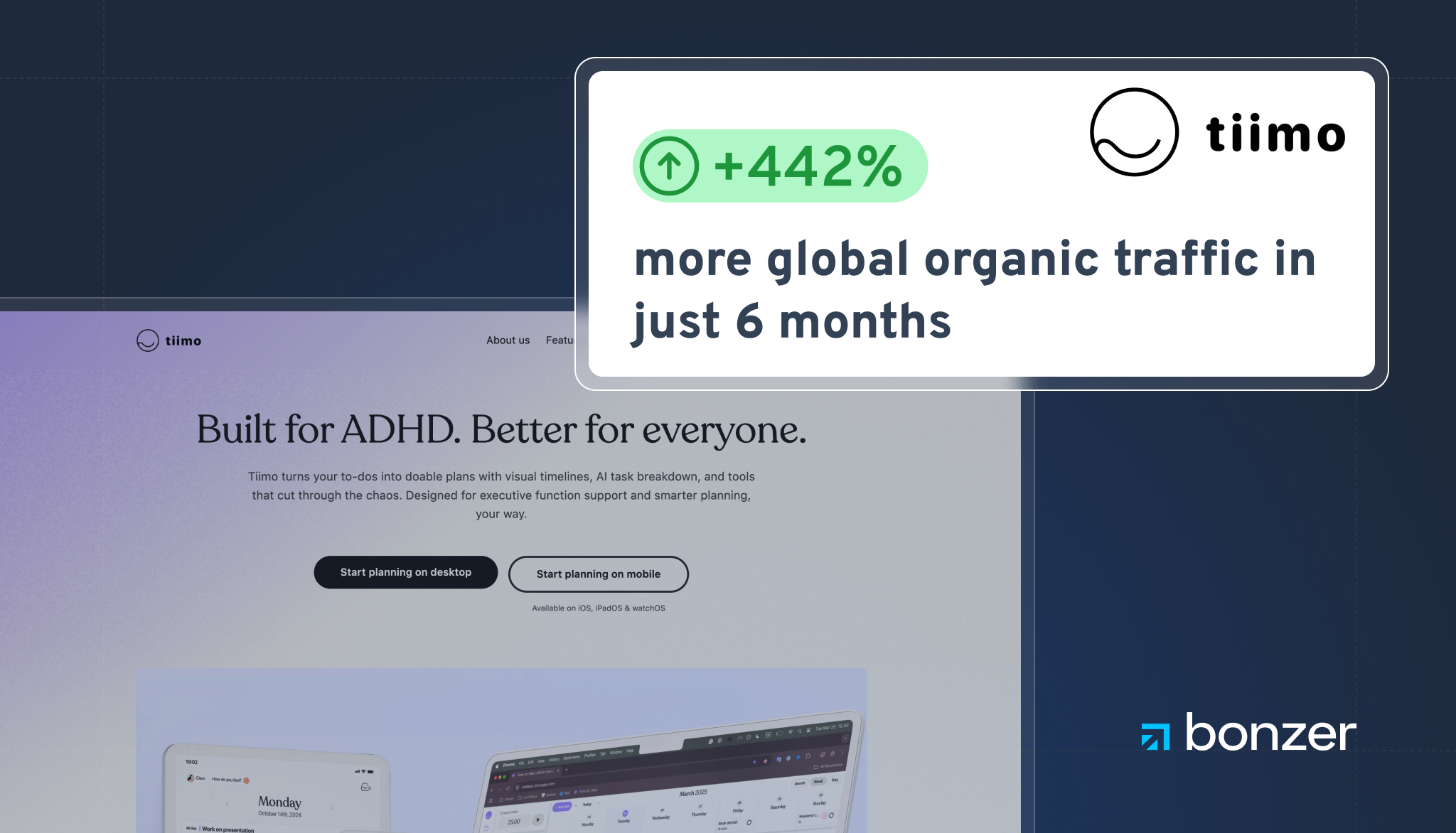

With the US as the primary market and Brazil, the UK, Germany and Japan close behind, locally optimized content put Tiimo in top positions across several markets.

An informal analysis of your domain. Classic search and AI-search.
Free SEO analysisBased on experience from more than 3,000 analyses and 1,000+ companies