


+2,670%referrals from AI Search
Pleo
Five markets, five content strategies, one scalable framework. Pleo is now the name that comes back when buyers ask an AI about business spend, and organic keywords in positions 1-3 grew 418%.

An SEO and AI strategy is one plan for your visibility, whether customers search in Google or ask ChatGPT, Copilot and Perplexity. We translate your business goals into a prioritized direction: which topics and surfaces are worth winning, in which order, and what that takes. It is the strategic core of a Baseline.
You get one direction instead of two parallel tracks. Classic search and AI search are two versions of the same buying journey, so we plan them in one document with one set of priorities. That saves the duplicated work, and it settles the internal argument about which track gets the budget.
You end up with a roadmap that decides what happens in the coming sprints, which content gets produced first, and how progress gets measured in the search engines and in the AI answers, month by month.
Your customers find answers in the search engines, and in ChatGPT, Copilot, Perplexity and AI Overviews. The same questions are now asked in several places, and the same strengths decide who becomes the answer.
So a plan for the search engines plus a side project for AI does not add up. Authority, content depth and a solid technical foundation carry both, and one joined-up strategy means you build them once.
We start with your business: which products, markets and audiences the growth has to come from. That decides which searches and questions are even interesting, in the search engines and in AI answers alike.
Then we map where you actually stand: where you rank, where you get named as a source, where competitors own the answer, and where there are gaps nobody has taken.
Last we prioritize by gain against effort and lay out a roadmap: what to win first, which deliverables that takes, and how progress gets measured. The plan is built to be executed from the first sprint.
One view of your starting point: visibility in classic search and AI answers, where competitors sit, and how your authority and content compare with the goals you have set.

You have set ambitious targets for organic growth and need to decide where the effort goes first. The strategy gives management, marketing and content one shared basis for the decision, and a Baseline to execute it from.
You already work seriously with SEO, but AI search is handled as a side project, or not at all. One joined-up strategy makes sure what you build for the search engines also positions you in the AI answers.
Business goals first: which revenue, which markets and which audiences the strategy has to move. Without that anchor, prioritization turns into gut feeling and roadmaps into wish lists.
Demand across surfaces: what your customers search for in the search engines, and what they ask ChatGPT, Copilot and Perplexity. Intent is the same lens in both places, whether the question is informational, comparative or purchase-ready.
Authority and E-E-A-T: which entities your brand should be connected to, where your expertise needs to be visible, and what it takes for search engines and AI models alike to treat you as a source worth trusting.
Content architecture: which topic clusters build topical authority, how pages connect through internal links, and where existing content can be lifted before anything new gets written. Pages in the middle of page one are usually faster wins than brand new topics.
Measurement: which KPIs show real progress on both surfaces, from rankings and traffic in classic search to visibility as a cited source in AI answers, and the leads and revenue that follow. You can see that connection played out in our cases.
And execution: the strategy points straight into the ongoing work in Baseline and the focused sprints that turn priorities into visible progress. Behind the deliverables runs our own platform Morrison, built on the experience from 8+ years and 1,000+ client projects.
One picture of where you stand across classic search and AI answers, a prioritization of topics and surfaces by business value, and a roadmap with deliverables and measurement. One plan, one set of priorities.
It is the strategic core of Baseline. We build it at the start of the partnership and revise it as we go, so the roadmap and the priorities follow your market and your results. It can also be delivered as a standalone engagement.
No. The demand is the same, there are simply more surfaces. The same foundation of authority, content and technical quality carries both, which is why we plan them together and weight them equally.
Usually 4 to 6 weeks from kick-off to a finished roadmap, depending on the number of markets and languages. We agree the scope up front, and you see the prioritization take shape long before the final handover.
We track which questions trigger AI answers in your market, how often you appear as a source, and what traffic and conversions the AI surfaces send. Together with the classic rankings that gives one picture of progress.
Yes, and it is a large part of why companies come to us. We run strategies across markets and languages from three Nordic offices, and we know the competition, the search behavior and the early AI adoption in each one. The same method carries into the rest of Europe and the US.
The AI surfaces move faster than classic search, so we adjust priorities continuously inside Baseline and revisit the full roadmap roughly every quarter. The strategy is a steering tool and has to keep pace with the market.
A strategy is only as good as the results it produces. Three partnerships where one plan for the search engines and AI search moved the numbers.
Five markets, five content strategies, one scalable framework. Pleo is now the name that comes back when buyers ask an AI about business spend, and organic keywords in positions 1-3 grew 418%.

A dictionary, a template archive and a blog, each built for a different search intent. In one year organic traffic grew 482% and the main conversions 1,288%.
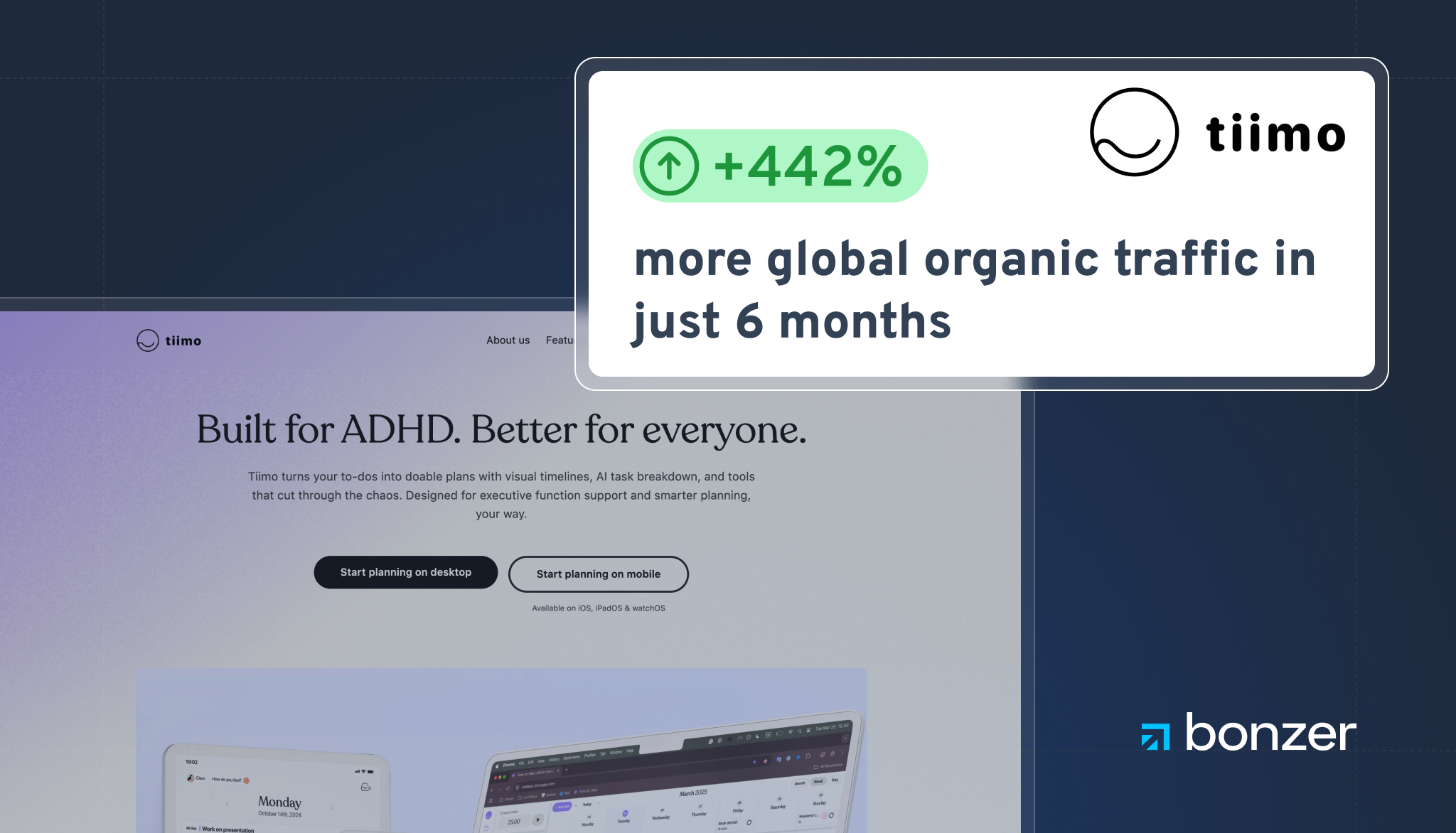

One strategy built for classic search results and AI interfaces at the same time gave Tiimo 442% more organic traffic from Google in just 6 months.

An informal analysis of your domain. Classic search and AI-search.
Free SEO analysisBased on experience from more than 3,000 analyses and 1,000+ companies