

+1,288%conversions from organic traffic
Contractbook
A dictionary, a template archive and a blog, each aimed at a different search intent. In one year organic traffic grew 482% and the main conversions 1,288%.

SEO copywriting covers all the content that has to be found: blog posts, guides, category texts, product copy and landing pages. To us, an SEO text is one that matches the search intent and is worth reading, because that is what ranks in the search engines and gets cited in AI answers. We write in your tone of voice, you approve everything, and production runs continuously in a Content Subscription.
The term has picked up a bad reputation, and it earned it. The web is full of heavy copy written for a search engine that never answers what the reader actually asked. That kind of writing ranks worse year by year, and it never gets cited when AI answers pick their sources.
A good SEO text is simply a good text, written with knowledge of what people search for and why. It answers the question, holds the reader, and makes it clear to search engines and AI models alike what you can do. That is the kind we write.
Behind every search sits an intent. Someone searching for 'boots' wants to see a selection. Someone searching for 'shoe size' wants a guide. Hit the wrong intent and neither length nor keywords will help: search engines measure whether the reader got an answer, and AI answers cite the sources that answer most clearly.
So every text starts with the intent behind the search. What kind of text does it call for, which questions does it need to answer, and what should the reader be able to do afterwards? That is the difference between copy that gets found and read, and copy that just gets published.
First we work out what the search calls for: a guide, a category text, a landing page or something else entirely. The search results and the AI answers show which form wins, and that analysis decides what we write before the first word goes down.
Then we write in your tone of voice. Our own platform Morrison has read your entire website and learned the brand from your own documents, so terminology and voice sit right from the first draft, and the specialists can spend their time on angle, research and precision.
And nothing goes live without your approval. You see every text, your feedback gets built into the production, and the quality therefore holds whether we deliver four texts a month or forty. The pace is agreed in the subscription.
A prioritized plan for what gets written: which searches and questions have demand, which form each text should take, and what sits closest to the business. So you know from the start why every single text is on the list.

You know what needs writing. There is just nobody to write it. With a fixed deliverable in the subscription, the content plan gets executed month after month, whatever else the quarter throws at you.
Or you publish steadily already, but the traffic does not follow. Then it is usually the intent, the structure or the updating of what already exists that is missing, before more of the same pays off.
The intent decides the form before the words decide the quality. The search results show whether a search calls for a guide, a category page or a comparison, and a beautifully written text in the wrong form does not reach page one. So the intent analysis is the first step in every brief.
Written for people is the method itself. Search engines have become good at measuring whether the reader got an answer, and AI models cite the texts that explain most clearly. The text that helps the reader best is also the one the machines pick, and the two concerns have merged.
Structure makes the text readable for both. Subheadings that answer real questions, bullet lists and tables where they ease the reading, precise entities and internal links that lead onward. It helps the reader through the text and makes it easy for an AI answer to cite.
The tone has to be yours all the way through. A text can rank and still grate if it does not sound like you. So we learn your tone of voice before we write, from your website and your own documents, and you approve every text before it goes live.
Copy works in groups. Guides build topical authority, category texts and landing pages convert it into business, and internal linking holds it together. So we plan the content as one connected universe, usually anchored in a Baseline or focused sprints.
And the effect has to be visible. At Contractbook, content was the core of the strategy: a dictionary, a template archive and a blog, each aimed at a different search intent. In one year organic traffic grew 482% and the main conversions 1,288%. There is more of that in our cases.
Production runs on Morrison, our own AI content ops platform, with our specialists as the writing editors. Every text is researched, angled and worked through by a person, and nothing goes live without your approval.
Morrison reads your entire website and learns the brand from your own documents before the first text is written. We calibrate the first deliveries with you: your feedback gets built into the production, so the voice sits precisely even as the volume grows.
Blog posts, guides, category texts, product descriptions and landing pages. We never lock the form in advance. Some searches call for a guide, others for a category page, and it is the analysis of the search results and the AI answers that decides what gets written.
That is agreed in the subscription, and the number can go up and down as needed. The important part is the rhythm: a fixed delivery every month, so the content plan gets executed instead of waiting for free hands. We recommend a level that matches the plan and your market.
Yes, and that is often where the fastest wins sit. Pages sitting in the middle of page one can frequently be lifted with a sharper intent, better structure and updated content, faster than a new text can be built from scratch. We assess what exists before we recommend anything new.
On rankings and organic traffic to the individual pages, on conversions, and on how often the texts get cited in AI answers. It goes into the ongoing reporting in the subscription, and it also steers the plan: we write more of what works.
No. The content plan sits with us and is built on search data, the competitive picture and your business goals, usually anchored in a Baseline. Your knowledge of products and customers makes the copy better, so we collect that in a short kickoff. After that your main role is to approve.
Good SEO copy is written for people and built to be found. Three partnerships where the copy carries a measurable share of the organic growth.
A dictionary, a template archive and a blog, each aimed at a different search intent. In one year organic traffic grew 482% and the main conversions 1,288%.


Content built on E-E-A-T and a dual-track content velocity model across five markets, with the blog sections carrying the topical authority.
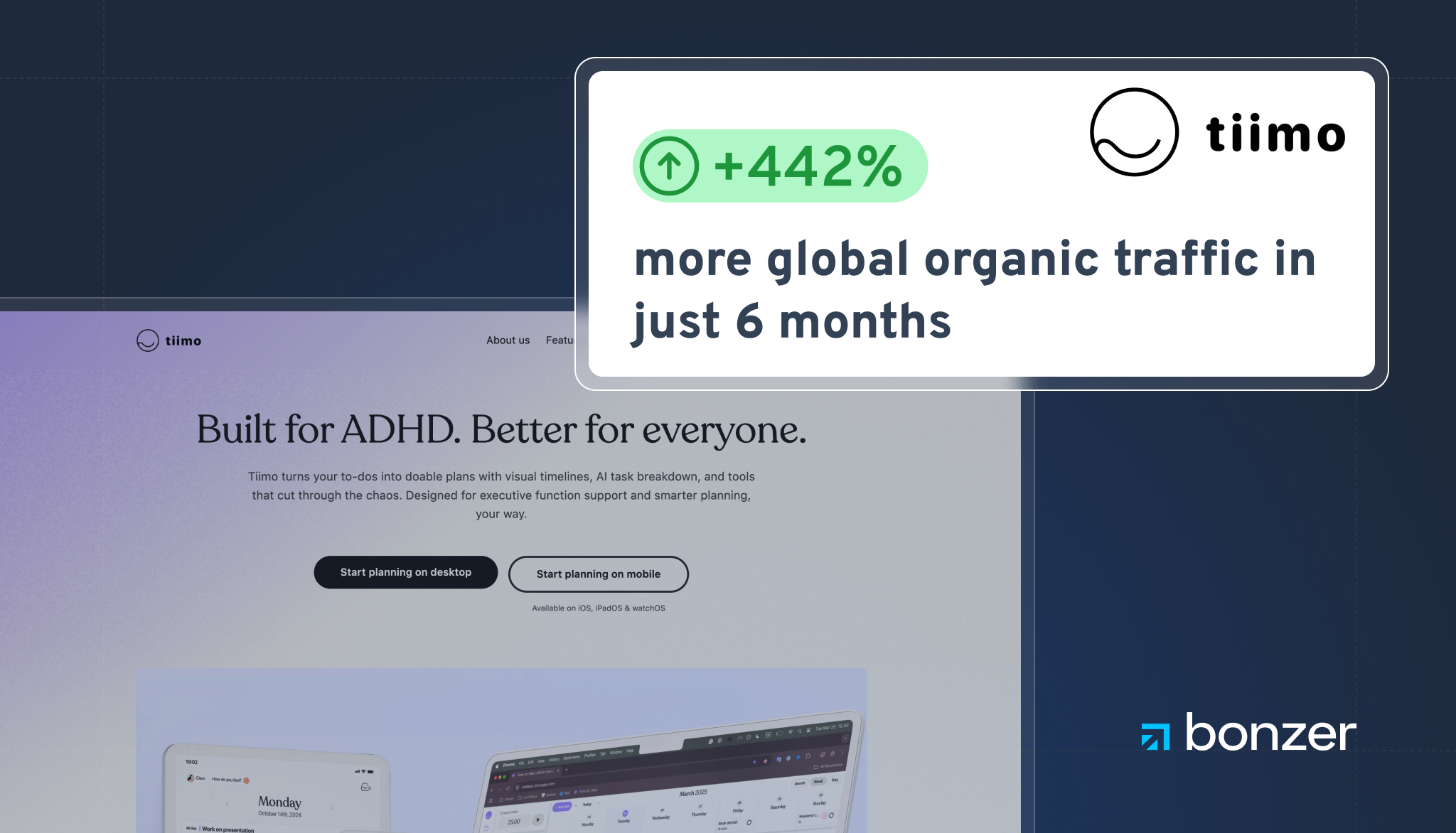

A pillar and cluster framework produced month after month took Tiimo from 188 to 812 keywords on page one of Google in six months.

An informal analysis of your domain. Classic search and AI-search.
Free SEO analysisBased on experience from more than 3,000 analyses and 1,000+ companies