

+2,670%referrals from AI Search
Pleo
When buyers ask an AI about business spend, Pleo is the name that comes back, in five markets. Pleo now holds 43.6% AI Share of Voice in its category.

A prompt analysis is the AI sibling of the keyword analysis. Where the keyword analysis maps what your customers type into a search engine, the prompt analysis maps the questions they put to ChatGPT, Copilot, Perplexity and Gemini: the answers that come back, the sources that get cited, and where you appear. It can stand alone, but it earns most as part of a Baseline.
Your customers research in classic search and in AI answers, often inside the same buying process. They compare suppliers in Google before lunch and ask ChatGPT for a recommendation after it. The analysis puts both halves of that behavior in one picture, so priorities rest on the whole demand and not just the part Search Console can show you.
You end up with a prioritized prompt landscape where the gaps are obvious: which answers already mention you, which ones competitors own, and which ones nobody has claimed. That becomes the starting point for briefs, content and the first sprints, right next to your classic keyword priorities.

A prompt is not a keyword. It is a whole question with context: the situation, the budget, the criteria. And where a search engine returns ten blue links, the platform gives one coherent recommendation in which certain brands and sources are named.
So the discipline is the same as in a keyword analysis, but the surface is new. You need to know which questions matter to your business, what the platforms answer today, and what it takes to become part of that answer. That is what the analysis delivers.
We start by mapping the prompts your customers realistically use, from early research through comparison to picking a supplier. The raw material is your keyword data, your customer conversations and market knowledge, so the list reflects how buyers actually ask.
Then we run the prompts systematically across the platforms and document the answers: which brands get recommended, which sources get cited, how you are described, and where competitors own the answer today.
Last we weigh gain against effort, side by side with your classic keywords. The result is a clear order of play: which answers to get into first, what content and which entities that takes, and what can wait.
One map of the questions your customers put to the AI platforms, split by intent: research, comparison and choice. Held up against your classic search demand, so you see the whole picture.

Your classic keyword work is under control, perhaps through a Baseline, and you want the same foundation for the AI surface before the next content plan is set.
You sell products or services that buyers research carefully before choosing. That is exactly where AI answers take up more room, and the brands that become the sources now are the ones that get recommended later.
The prompt landscape is the starting point. We build it from your keyword data, Search Console, the questions sales and support hear every week, and our own market knowledge, then phrase the prompts the way real buyers do: with context, criteria and a situation.
The platforms answer differently. ChatGPT, Copilot, Gemini, Perplexity and Google's AI Overviews pick sources and phrase recommendations in their own way, so we document the answers platform by platform.
The sources behind the answers show the way in. We map which pages, publications and datasets the platforms cite in your category, and hold that up against your own entity coverage, authority and content depth. This is where E-E-A-T becomes measurable: platforms pick sources they have reason to trust.
Your brand mentions are a deliverable in themselves. We document whether you are named, how you are described, and whether that description is accurate. An answer that gets your product wrong is a visibility problem too, and the right sources can correct it.
Classic SEO runs through all of it. The same demand shows up in both places, so we compare the prompt landscape with your keyword priorities and find the topics where one piece of work wins in both places. Much of the content that wins AI answers is the content that wins page one.
Finally we filter by business: which prompts sit closest to a supplier decision or a purchase, and where a place in the answer is worth the most. That is what turns the analysis into a plan rather than a reference document, and it is the same approach behind the results in our cases.
They are siblings. The keyword analysis maps demand in classic search, the prompt analysis maps the questions your customers put to the AI platforms and the answers they get. They share data and the same prioritization logic, and they are strongest together, because it is one demand asked in two ways.
ChatGPT, Copilot, Gemini, Perplexity and Google's AI Overviews. We weight them by where your audience actually researches, so the effort follows your buyers rather than the platform with the loudest press coverage.
We build the prompt landscape from your keyword data, Search Console, the questions your sales and support teams field, and our own market knowledge. Then we validate it against the answers the platforms actually give, so the map reflects real buying journeys.
Yes. We document brand mentions, cited sources and descriptions across a fixed prompt set, which gives you a zero point you can re-measure. Combined with the traffic the AI platforms send into your analytics, you can follow the development over time.
Most engagements land at two to four weeks, depending on the number of platforms, languages and markets. Scope is fixed from the start, so you know what you get and when you get it.
Yes, and that is where it earns most. Answers differ by language, so we run the prompt set per market. Multilingual work is our everyday across the Nordics, and the same method carries into the rest of Europe and the US.
Answers move, which is exactly why the prompt set is built for re-measuring. As part of a Baseline we rerun it regularly, so what you hold is a trend line, not a snapshot.
A prompt analysis shows where you appear in the AI answers, and where your competitors do. Two partnerships where the AI work can be read straight off the traffic from ChatGPT and the other platforms.
When buyers ask an AI about business spend, Pleo is the name that comes back, in five markets. Pleo now holds 43.6% AI Share of Voice in its category.
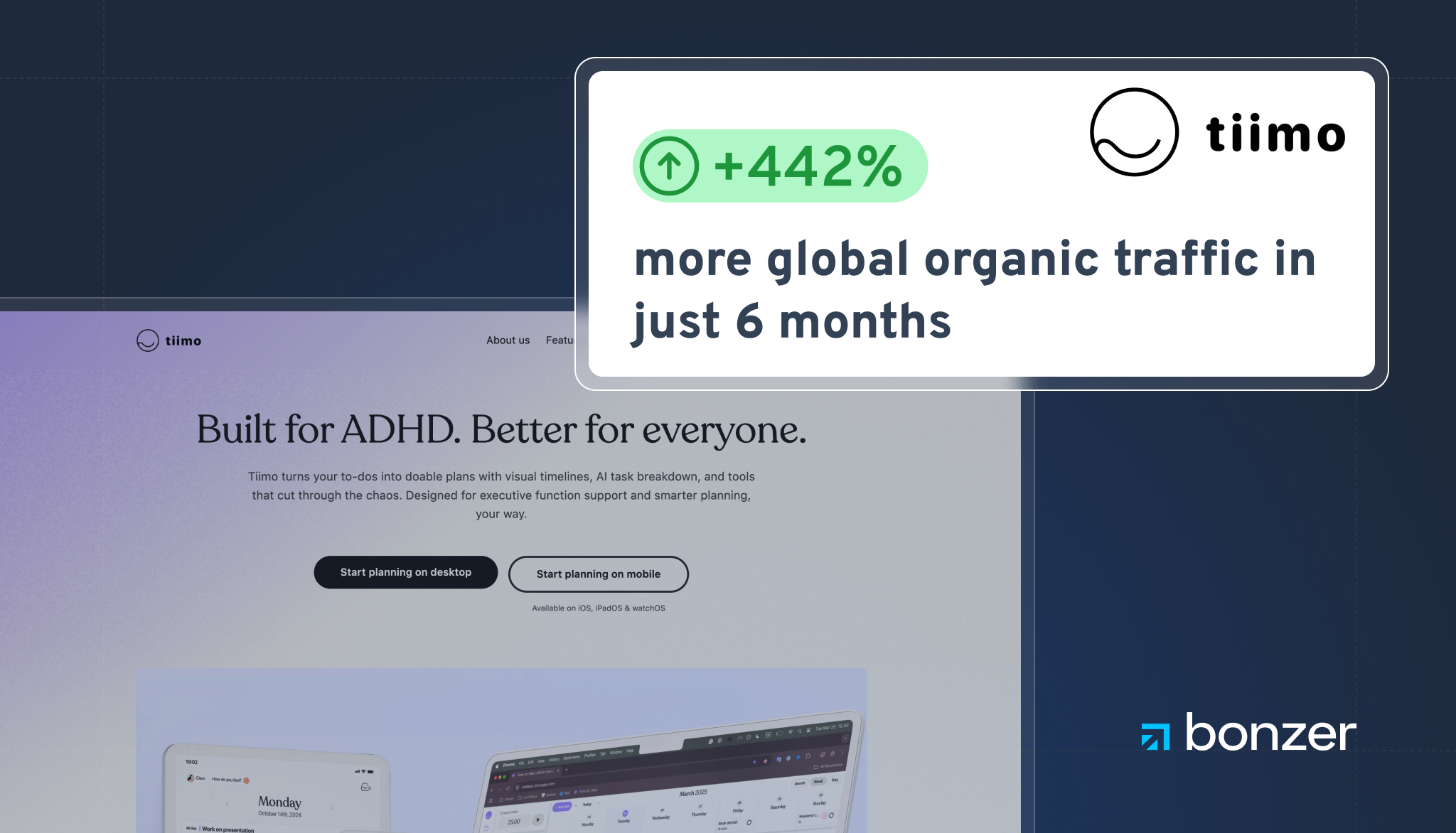

A strategy aimed at Google and the AI platforms at once gave Tiimo 442% more organic traffic and 657% more key events from ChatGPT in six months.

An informal analysis of your domain. Classic search and AI-search.
Free SEO analysisBased on experience from more than 3,000 analyses and 1,000+ companies