

+1,288%conversions from organic search
Contractbook
Free templates and a legal dictionary, each aimed at a different search intent, made organic search Contractbook's strongest conversion channel in a single year.

Conversion rate optimization (CRO) is about what happens after the click. We analyze the pages your visitors land on from search engines and AI answers, find where they hesitate or drop off, and change the pages so more of them turn into leads and sales. It usually runs as a sprint on top of your Baseline.
SEO and CRO are two halves of the same equation. Visibility decides how many people come in. The conversion rate decides what each visit is worth. The second number is often the cheaper one to move.
The work builds on data you already have: behavior on the pages, the search intent behind the traffic, and the questions people ask right before they choose a supplier. We do not need new truths from outside. They are already there in what your visitors do.

Plenty of websites already get enough visits to grow. But the landing page does not match the intent behind the search: the category page does not answer what people came for, the form asks for too much, or the argument that closes the sale sits three scrolls down.
AI answers are changing who lands with you. When ChatGPT or an AI Overview has done the research, people arrive further along in the decision and with higher expectations. The page has to confirm the choice and make the next step obvious, instead of starting the argument over.
We start in the data: which pages traffic from classic search and AI answers lands on, what intent sits behind the visit, and where in the flow people drop off. We read behavioral data and search data together, so the patterns show up.
Then we write hypotheses and prioritize them by gain against effort. Pages with a lot of traffic and a low conversion rate go first. The changes range from messaging and page structure to forms, trust signals and calls to action.
Finally we implement and measure. Where volume allows it, we test variants against each other. Where it does not, we measure before and after against clearly defined goals, so you know what worked and what did not.
A review of the pages your search traffic lands on: where people drop off, where the page misses the intent, and where the biggest losses sit. Prioritized by traffic and commercial value.

Your visibility is growing through Baseline and sprints, and more people land on the pages every month. A conversion sprint makes sure that progress also shows up in leads and revenue.
You are launching new category pages, landing pages or a new flow, and you want the conversion built in from the start, while the templates are still on the drawing board.
The first question is always whether the page answers what people came for. A page can rank perfectly and still convert badly, because it talks to research when the visit is ready to buy, or the other way around. Intent match is the foundation, and everything else builds on top of it.
Then friction: how many steps there are to action, what the form asks for, how clear price and process are, and whether the page works as well on mobile, where a large share of search traffic lands.
Credibility decides the close calls. The same signals that strengthen E-E-A-T in search, documented experience, a clear sender, results you can point to, are the ones that make a visitor trust you enough to reach out.
We treat traffic from AI answers as its own segment. Those visitors have had the comparison served to them and often land deep in the site, so we test whether the subpages can stand alone: can you understand the offer, see the next step and act without going via the homepage.
Measurement sets the frame. Together we define what a conversion is worth to you, a lead, a demo, a purchase, and set up tracking so the effect can be counted in revenue and leads.
And because the work happens on the same pages your visibility is built on, we coordinate every change with the SEO strategy, so conversion work never costs you rankings. Several of our cases are built on exactly that interplay.
A conversion analysis of the pages your search traffic lands on, a prioritized hypothesis backlog, and help with implementation and measurement. We agree the scope at the start: typically a defined set of page types or individual pages, not the whole site at once.
No, but the method adapts. With high volume we can A/B test variants against each other. With lower volume we work with before-and-after measurement on clearly defined goals and lean more on behavioral data and intent analysis. The prioritization always starts with the pages where there are actually visits to convert.
Both models work. We can deliver precise descriptions and briefs to your own team, or make the changes ourselves where your platform allows it. We agree that at the start, so the backlog does not get stranded between two teams.
That is exactly why CRO sits together with SEO here. Every change is weighed against search intent, content coverage and structure before it goes live. The advantage of one agency on both disciplines is that conversion and visibility never get optimized in opposite directions.
Two ways. Visitors from AI answers are typically further along in the decision and land deep in the site, so the pages have to stand alone and make the next step obvious. And the clear answers and structures that convert people are the same content AI models prefer to cite, so the conversion work quietly improves your odds of being quoted.
We define the goals before anything changes, whether that is leads, demos or sales, and set up the tracking from day one. We settle the effect as an A/B test or a before-and-after measurement, and report the results into your ongoing Baseline reporting, so you can read conversion and visibility in the same picture.
The analysis and the prioritized backlog are usually ready within the first weeks of the sprint. How quickly the effect shows depends on how fast the changes go live and on the traffic volume on those pages. We deliberately prioritize changes with a short path to measurable effect first.
Visibility is only the first step. These two collaborations show what happens when the pages are also built to convert: more conversions and more key events out of the same organic traffic.
Free templates and a legal dictionary, each aimed at a different search intent, made organic search Contractbook's strongest conversion channel in a single year.
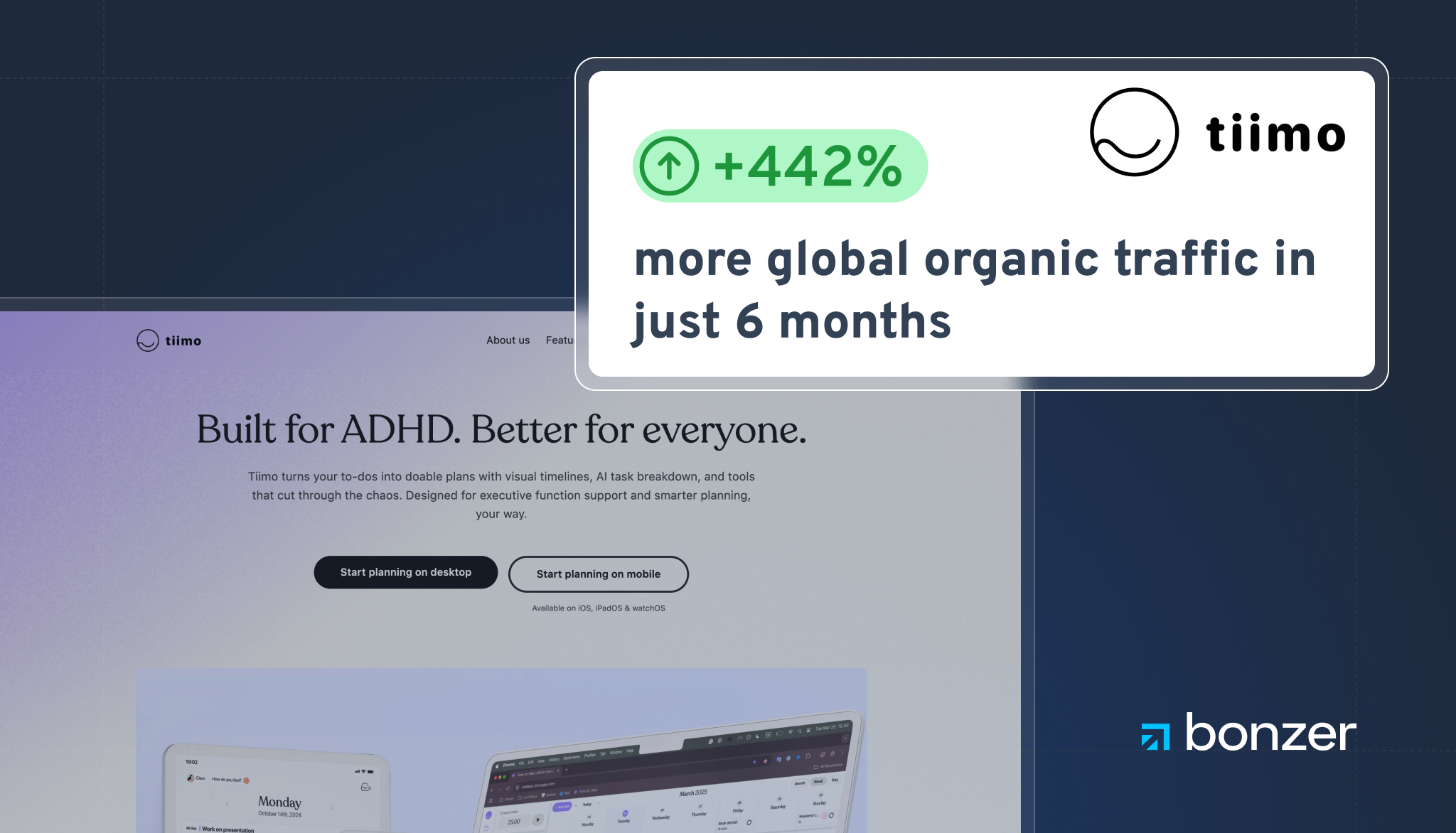

Pages written to stand alone as an answer turned visitors arriving from ChatGPT into measurable key events for the ADHD app.

An informal analysis of your domain. Classic search and AI-search.
Free SEO analysisBased on experience from more than 3,000 analyses and 1,000+ companies