

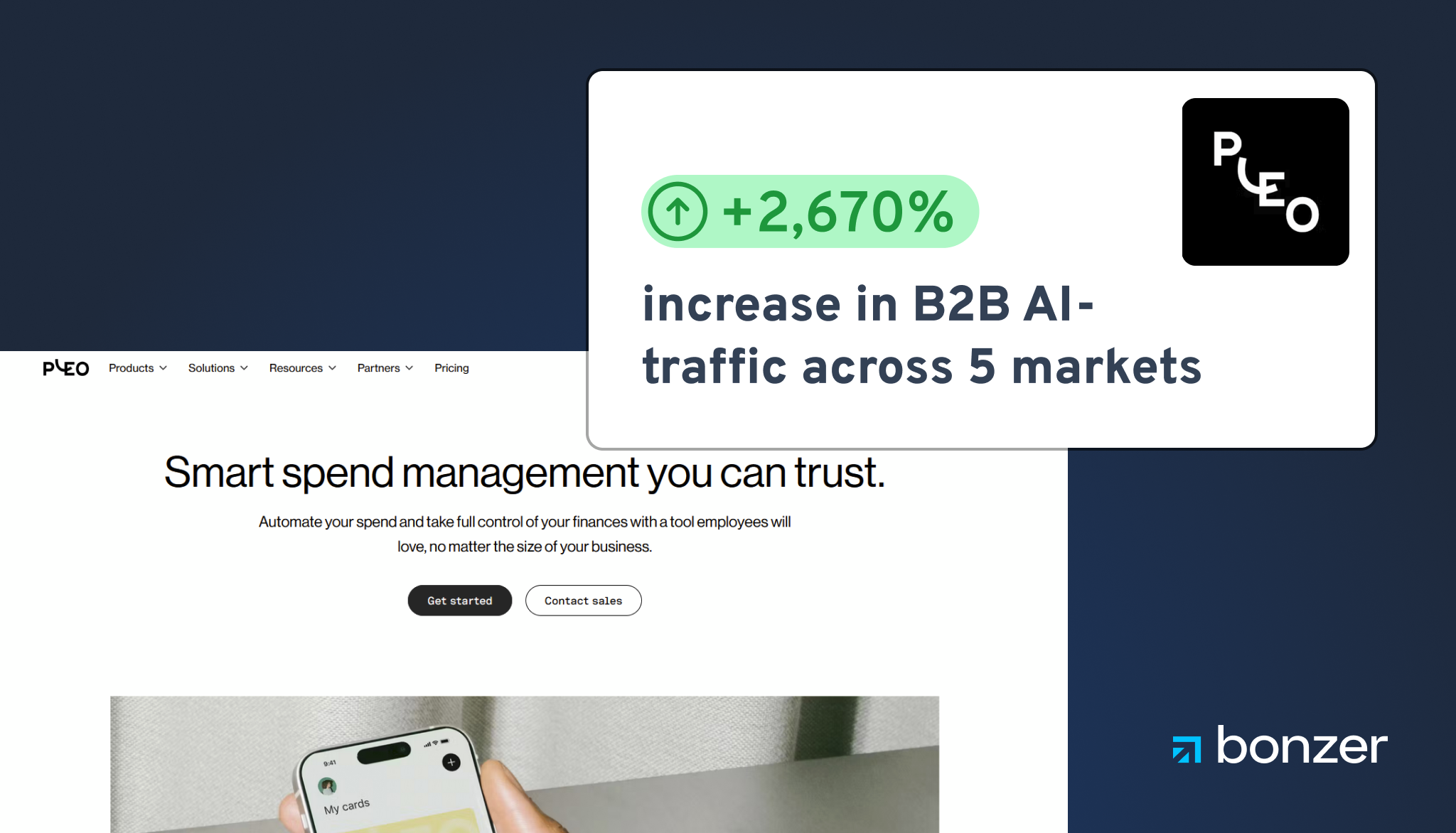

+2,670%referral traffic from AI Search
Pleo
Five dedicated content strategies with the blog sections at their core gave Pleo market-leading topical authority across five markets. Organic keywords in positions 1-3 grew +418% over the same period.

We build blog posts and articles in clusters: connected content that covers a topic from the first curious question to the purchase-ready comparison, planned around intent and published on a steady rhythm. It is the core delivery in our Content Subscription, usually running on top of a Baseline.
Every post has a job to do. It answers a question people actually ask, matches the intent behind it, and links into the rest of the cluster. That is what turns a blog from a publishing habit into an asset the business can lean on.
The compound effect is topical authority. Search engines and language models learn that your site is where the topic is covered best, and that position shows up twice over: in the rankings, and in the sources AI answers quote.

Most blogs are assembled from one-off articles: written when there was time, about whatever looked obvious that month. Each one is fine on its own, and none of them are connected. Search engines read scattered signals, and readers never find the way to the next answer.
Classic [SEO](/seo) and AI answers reward the same thing: depth and coherence. Cover a topic systematically, with precise entities and internal linking, and you lift rankings in the search engines while raising the odds of being cited when ChatGPT or Perplexity answers your customers' questions.
The plan comes first. Working from the keyword analysis, we split the demand into clusters: which questions belong together, what intent sits behind each of them, and in which order the content should go live to build authority fastest.
Then we produce. Every post gets a brief with its angle, its intent and its place in the cluster. Morrison, our own AI content ops platform, has read your entire site and learned your brand, so research and structure are settled before our specialists write and edit. You approve before anything goes live.
And we keep following the work. We track coverage, rankings and citations in AI answers, update the posts that sit close to a breakthrough, and adjust the plan to what the data shows. The rhythm stays fixed; the priorities stay live.
A living content plan that shows which clusters we are building, what question each post answers, and why the order is what it is. You always know what is coming next and what it is meant to move.

You have a Baseline or a finished keyword analysis, so you know where the demand sits. Now the priorities need to become content, on a rhythm that holds through a busy quarter.
Or you already publish, and traffic has flattened out. Usually the cause is coherence: clusters that hang together, internal linking, and content that answers the intent it was written for.
Intent decides the format. A question asked early in the research phase needs a different answer than a purchase-ready comparison, and a short post that hits the intent precisely almost always beats a long one that lands next to it.
The cluster supplies the context. A pillar post covers the topic broadly, supporting posts go deep on each sub-question, and internal linking ties them together so readers and crawlers can both see the structure.
Authority has to be readable in the text itself. We work with E-E-A-T and entities: real examples, precise terminology and visible sources, so the content demonstrates the experience it is claiming.
AI answers cite sources that are easy to cite. A clear answer high on the page, tightly scoped sections and consistent terminology throughout make your post the passage ChatGPT, Perplexity and AI Overviews reach for when the question comes up.
New is not automatically better. A post sitting mid page one that gets more depth and fresher data often moves faster than a brand new article, so the plan always holds both kinds of work.
And the progress has to be visible. We report on coverage and rankings across the whole cluster, so you can follow the authority building. Our cases show how far that compounds.
It depends on scope and how many markets you publish in, and we set the rhythm in the content plan so it matches your ambitions. The order matters more than the count: the right posts in the right sequence build authority faster than a bigger, looser pile.
We use Morrison, our own AI content ops platform, for research, structure and consistency. It has read your entire site and learned your brand from your own documents. The writing and the editorial judgement sit with our specialists, and you approve everything before it is published.
We start from your tone of voice, your existing material and the language your industry actually uses, and we calibrate the first posts closely with you. Nothing goes live before you have read it, so the voice gets corrected while there are still only a handful of articles to adjust.
Topical authority takes months to build. The first movement usually shows on long-tail questions and updated posts, while the broad rankings and AI citations follow as the clusters get covered. We report continuously, so you can see the direction while it happens.
Yes, and that is the reason it matters more. AI answers are assembled from sources, and the sources are usually the pages that cover a topic thoroughly and clearly. Strong cluster content is exactly what gets quoted, and classic search still drives the clicks and conversions alongside it.
Yes. Some clients write the most specialist pieces themselves while we handle the plan, the briefs, the optimization and the rest of the production. We settle on the split that puts your in-house knowledge where it counts most.
No, but it is the strongest combination. The Baseline keeps strategy, prioritization and measurement in place while the subscription delivers the content. If your plan is already clear we can start straight into production, or open with a focused engagement in sprints.
Ongoing articles are a long-term investment, and one you can measure along the way. Here are three collaborations where blog content and specialist articles built topical authority cluster by cluster.
Five dedicated content strategies with the blog sections at their core gave Pleo market-leading topical authority across five markets. Organic keywords in positions 1-3 grew +418% over the same period.

A blog, a legal dictionary and a template archive, each aimed at a different search intent. Organic traffic grew 482% over the year, and the conversions that matter grew 1,288%.
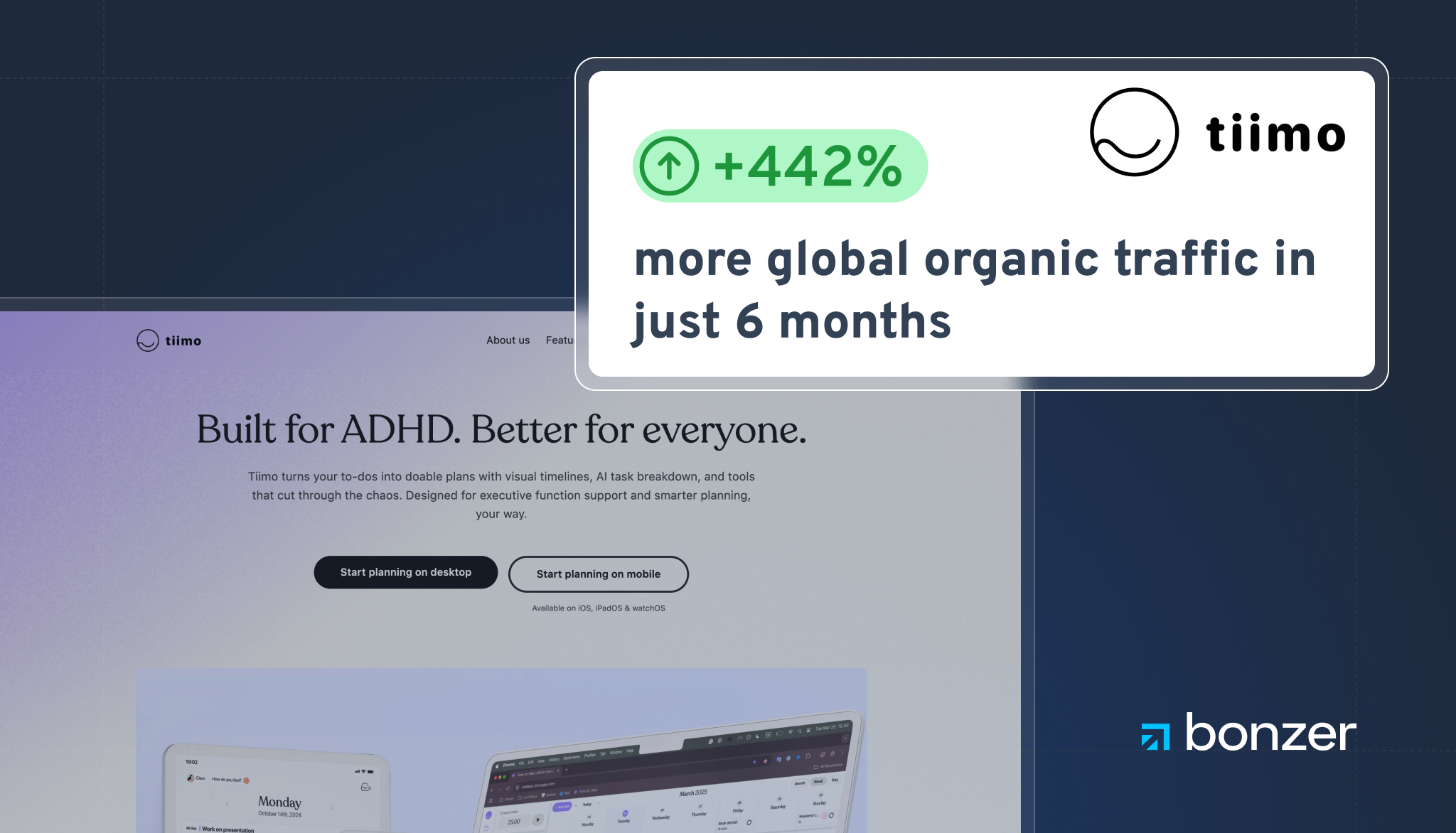

Six months of E-E-A-T driven articles lifted Tiimo's page 1 rankings on Google by +331% and put the app into AI Overviews and ChatGPT answers about ADHD.

An informal analysis of your domain. Classic search and AI-search.
Free SEO analysisBased on experience from more than 3,000 analyses and 1,000+ companies