

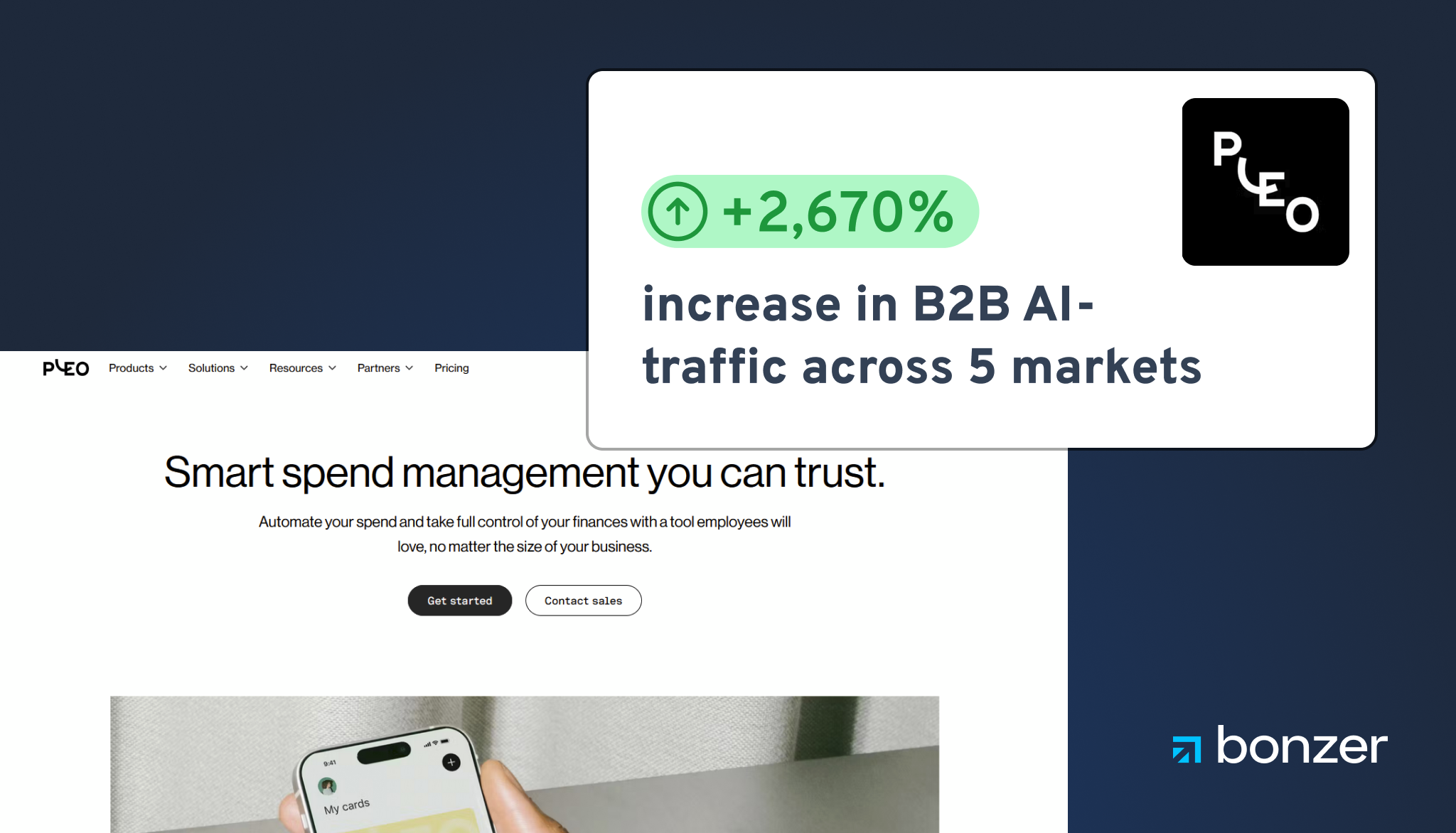

+2,670%referrals from AI Search
Pleo
Pleo now gets found and cited in AI search across five markets, and the visibility can be read straight off the traffic.

When ChatGPT, Copilot, Perplexity or Google's AI Overviews answer a question, they build the answer on sources. Generative AI optimization is the execution against the language models: we rewrite, restructure and mark up your content so the models understand who you are and cite you in their answers. Where AI search optimization is the strategy and the ongoing visibility program in your Baseline, this is the focused sprint that carries the work out onto the pages.
This is not a new discipline sitting next to SEO. It is SEO on a new surface. Structure, entities and authority decide both who ranks in the search engines and who gets cited in AI answers.
You get something you can act on: a picture of how visible you are in AI answers today, a prioritized plan for entities and structure, and pages optimized to be picked as the source.

Your customers no longer research in one search engine only. They ask, compare and decide across Google, ChatGPT, Copilot and Perplexity, and the answers rest on a small selection of sources the models judge to be credible and easy to understand.
Those sources are rarely random. Clear structure, precise entity coverage and consistent information across the web decide who gets cited. Those are the same qualities classic search rewards, so the work lifts your rankings in the search engines in the same motion.
We start by mapping how you appear in AI answers today: which questions your market asks, which entities the models connect you with, and which sources get cited where the answer ought to be you.
Then we prioritize. Some pages need restructuring so paragraphs can stand alone as an answer. Others are missing definitions, data or schema markup. And some topics are missing altogether before the models can connect you with them.
Finally we execute as a sprint with a fixed frame: rewrites, structure and markup go live, and we measure whether your visibility in AI answers and your classic rankings move.
An overview of where you stand: which questions your market asks across search engines and AI assistants, where you get named or cited today, and which sources own the answers you should own.

You are strong in classic search, but rarely get named when ChatGPT or Perplexity make a recommendation in your category. The foundation is already there, and the head start is yours to take.
You already run a Baseline and want a focused engagement that brings the AI surface along, without pulling attention away from the rest of the work.
Entity coverage is the foundation. Language models understand the world through entities, brands, products, people, concepts, and the relations between them. We make sure your core topics are covered precisely enough that the models connect you with the questions you want to own.
Being quotable is a matter of structure. Paragraphs that can stand alone as an answer, clear definitions, tables and summaries make it easy for a model to lift your content into an answer, and easy for a reader to get value straight away.
Technical readability decides whether the models get in at all. We review schema markup, crawl access for AI crawlers and the semantic build of the page, so the content can be read by Googlebot and by the models' own crawlers.
Authority forms across sources. AI answers reward consistency: your name, your numbers and your claims lining up on your own site and in the places the models otherwise take their knowledge from. That is E-E-A-T in practice, and it lifts your classic rankings at the same time.
Along the way we use our own platform, Morrison, which reads your entire website and knows your brand from your own documents. That keeps each optimization working with the rest of the site instead of pulling in a different direction.
And we measure from day one: which questions you show up in, where you get cited, and what the traffic from those platforms is worth next to your classic visibility. The same systematic approach runs through our cases.
The surfaces differ, the foundation is the same. Structure, entities and authority decide both rankings in the search engines and citations in AI answers. The difference sits in the format: AI answers need paragraphs that stand alone, clear definitions and consistent data. We optimize for both in the same pass.
Yes. We follow which questions you appear in, where you get named or cited in AI answers, and what traffic from the AI platforms means in your own numbers, alongside your classic rankings. We agree the measurement setup before the sprint starts, so we are measuring the same things all the way through.
Some things move quickly. Structural changes and markup can be picked up shortly after they go live by the models that search the web in real time. Authority and consistency across sources take months to build. We are honest about that difference from the start, so the expectations hold.
No, and you do not have to. It is the same dynamic: people looking for companies. Work on structure, entities and authority earns the ranking and the citation in the same pass, so there is only one job to fund.
Access to your CMS and Search Console, a short brief on your commercial goals, and ideally a couple of hours with your subject-matter experts along the way. Their knowledge is often what makes the content quotable. We drive the rest.
The sprint is built to sit on top of a Baseline, where analysis and strategy are already in place. It can run on its own, but the effect is biggest when the optimizations get followed up continuously. We will tell you honestly what makes sense in your situation.
ChatGPT, Copilot, Perplexity, Gemini and Google's AI Overviews are the core. The platforms fetch their sources differently, but they reward the same qualities: clear structure, precise entities and credible information. We prioritize by where your audience actually researches.
Generative AI optimization is about being picked as the source when the language models answer. These two collaborations show what it looks like when that works, in ChatGPT, AI Overviews and the platforms alongside them.
Pleo now gets found and cited in AI search across five markets, and the visibility can be read straight off the traffic.
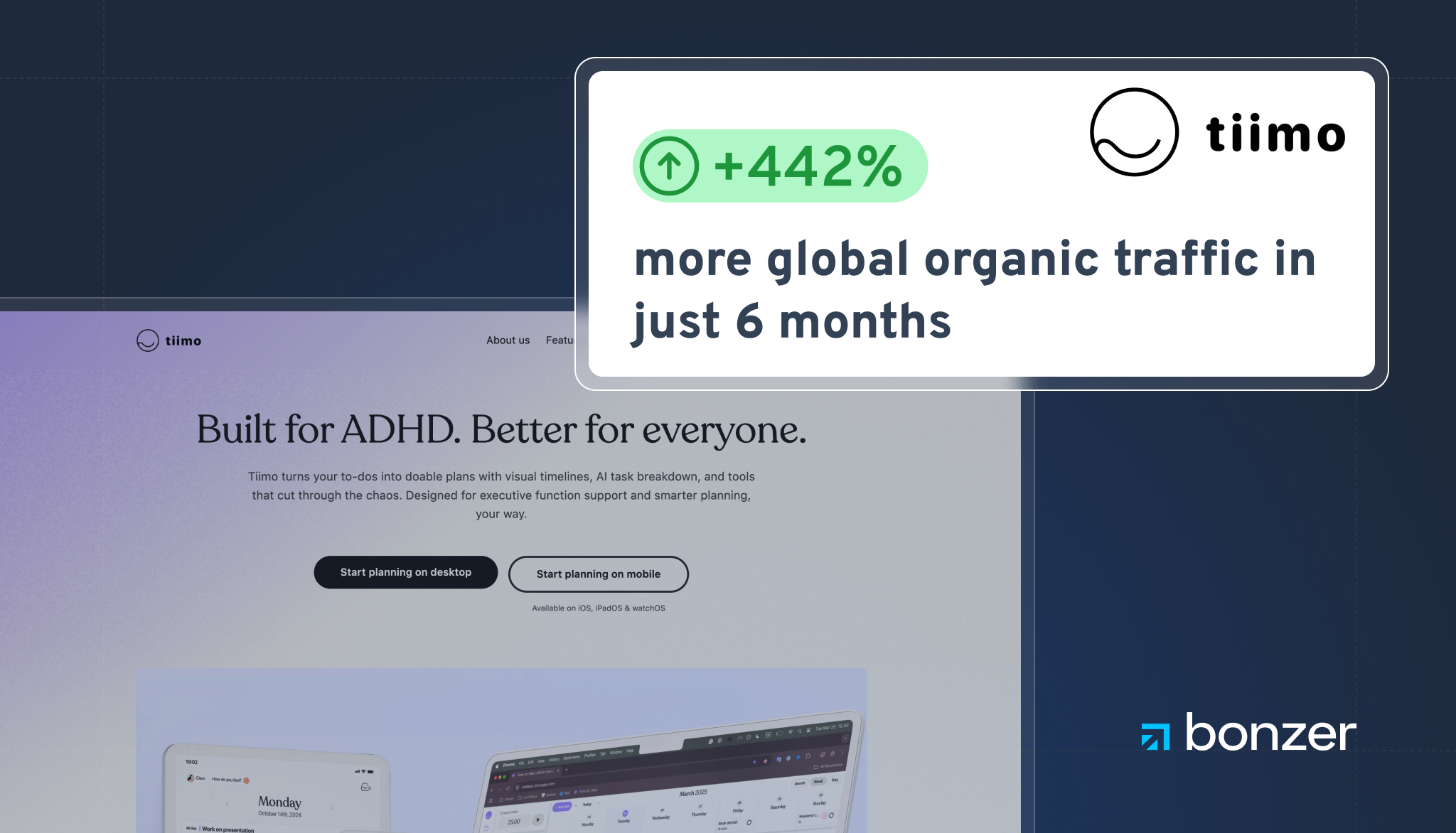

Ongoing optimization across several languages, with E-E-A-T as the guide, made Tiimo part of the top results in Google's AI Overviews.

An informal analysis of your domain. Classic search and AI-search.
Free SEO analysisBased on experience from more than 3,000 analyses and 1,000+ companies